Rules you can cite, explain and test

Every rule versioned.Every change explained.Every system tested.

Illustrative Normlith rule registry holding models for payments, refunds, claims, eligibility. In the refunds model, requirement RF-2.1 is defined, version 2.0.0 explains the change as a correction naming finding F-7, and 3 of 3 tests pass (RF-T1, RF-T2, RF-T3).

Rule registry

  • Payments
  • Refunds
  • Claims
  • Eligibility

RuleRF-2.1Requirement

A refund is issued within 14 calendar days of the request being received.

DefinedOne permanent id, cited everywhere

Changev2.0.0Correction

A refund is issued within 14 added: calendar days of the request being received.

F-7 Five sources gave five refund windows.

ExplainedNames the finding behind it

Tests3 / 3Check set 2.0.0

  • RF-T1Refund on day 10 is on time
  • RF-T2The clock starts on receipt, not approval
  • RF-T3Day 15 is late, weekends included

PassingTested against the rule

  1. Rule

    RF-2.1

    Defined

  2. Change

    v2.0.0

    Explained

  3. Tests

    3 / 3

    Passing

One connected, traceable specification

Define each rule once, keep the reason for every change, and prove your systems follow it.

The problem

One rule. Five answers. Which one does your code follow?

Business rules get copied into policies, wikis, decks and code, and the copies drift apart. Customers hear different answers, systems enforce the wrong one, and no one can show which is right. Normlith keeps one authoritative version of each rule, and every copy points to it.

The conflictFive places. Five different answers.

  • Refund policy, 2023 edition, page 7

    Refunds are issued within 14 days of the request.

    Refund policy14 days

  • Team wiki, last edited two years ago

    Refunds: 14 working days.

    Team wiki14 working days

  • refund_service.py

    REFUND_WINDOW_DAYS = 21

    Source code21 days

  • Onboarding deck, slide 12

    Refunds in 10 working days

    Onboarding deck10 working days

  • Support ticket 4471

    Agreed 30 days as a one-off. Treat as standard going forward?

    Support ticket30 days

The fixNormlith draws them into one rule.

RF-2.1Version 2.0.0, published and fixed

A refund is issued within 14 calendar days of the request being received.

The resultNow each one cites it, and can't drift.

  • Refund policy cites RF-2.1
  • Wiki cites RF-2.1
  • Code tested against RF-2.1
  • Deck cites RF-2.1
  • Support macro cites RF-2.1

The recordAnd every change to it keeps its reason and evidence.

Illustrative Normlith model page for refunds: clause RF-2.1, its change history, and the evidence behind each version.

ModelsRFRefunds

Publishedv2.0.0

Clause

Requirement RF-2.1

Version 2.0.0: A refund is issued within 14 added: calendar days of the request being received.

Why this version

Finding F-7 found five sources giving five refund windows. The window is now calendar days, and the case-by-case extension in RF-2.3 is retired.

Change history

Evidence

Research finding F-7 Refuted

Teams assumed one refund window. The policy, wiki, code, deck and support gave five.

Tested against 1.1.0

Check set 2.0.0

3 of 3 test vectors passing

  • RF-T1Refund on day 10 is on time
  • RF-T2The clock starts on receipt, not approval
  • RF-T3Day 15 is late, weekends included

Illustrative model. Struck through: removed. Underlined: added.

RF-2.1Version 2.0.0, correction

  • Changed14 added: calendar days
  • WhyFinding F-7 Refuted Teams assumed one refund window. The policy, wiki, code, deck and support gave five.
  • Checks3 of 3 test vectors passing

Without NormlithFive answers, and none of them the authority.

With NormlithOne clause. The policy, wiki, deck, code and support replies all point to it, and the code is tested against it.

Illustrative example.

What is Normlith?

The system of record for your business rules. One place to define each rule, explain every change to it, and verify that your systems follow it.

  1. Define

    Each rule is written once, as a numbered clause that policies, guides and code all cite.

  2. Explain

    Every change is a new version, with its reason and evidence on record.

  3. Verify

    Each version ships tests for your systems, and can't be published until they pass.

Without it Rework, slower decisions, preventable defects and difficult audits.

See how it works

How it works

Follow one rule through all four parts.

  1. Models

    Each business system becomes numbered clauses held in one registry. Every clause has a permanent id you can cite.

  2. Bound papers

    Policies, guides and other documents quote clauses directly from the version they explain, so the explanation and the rule can't disagree.

  3. Research records

    Questions, assumptions, findings and decisions are kept as records. A correction must name the finding that prompted it.

  4. Conformance

    Every version ships a machine-readable package to test an implementation against. Failing test vectors block publishing.

Illustrative Normlith model page for refunds, version 2.0.0, in four views: its clauses, the papers that cite RF-2.1, finding F-7 behind the last correction, and an implementation tested against the check set.

ModelsRFRefunds

Publishedv2.0.0

  1. Clauses4
  2. Cited by4 papers
  3. EvidenceF-7
  4. Your code2 / 3
  • RF-1.2StateRequested, approved, issued or refused
  • RF-2.1RequirementIssued within 14 calendar days of the request being received
  • RF-2.2PreconditionOnly a paid order can be refunded
  • RF-2.3RequirementExtensions agreed case by caseRetired in 2.0.0

Refund policy, 2026 editionQuotes 2.0.0

Customers are refunded within 14 calendar days of us receiving their request Refund window RF-2.1

Onboarding deckQuotes 1.1.0

A newer version, 2.0.0, is available.

Research findingF-7Refuted

Teams assumed one refund window. The policy, wiki, code, deck and support gave five.

Tested against 1.1.0. Led to the correction in 2.0.0.

refund_service.py against check set 2.0.0

  • RF-T1Refund on day 10 is on time
  • RF-T2The clock starts on receipt, not approval
  • RF-T3Day 15 is late, weekends includedExpected late, got on time. The code still allows 21 days.
See conformance checks at work

Illustrative model.

Conformance

Rules your systems are held to.

Test any implementation against a version's package. Nothing publishes while its checks fail.

RefundsRFDraft 2.1.0

Conformance package

rf-2.1.0.json

{
  "model": "RF",
  "version": "2.1.0",
  "clauses": ["RF-1.2", "RF-2.1", "RF-2.2"],
  "vectors": [
    {
      "id": "RF-T3",
      "given": { "received": 0, "issued": 15 },
      "when": "check_window",
      "then": { "on_time": false }
    },
    ...
  ]
}

Machine-readable and fixed. Its fingerprint is recorded when the version is published.

Publish checks

  • Every modified clause marked normative or editorial
  • Reason for the change written for the change log
  • Correction names its finding, F-11
  • 1 test vector failing, RF-T4

Publishing blocked

Fix the implementation or the rule, then run the checks again.

$ npm run models:check-vectors -- --draft
Checking the RF draft against the reference implementation
  RF-T1   Refund on day 10 is on time                  pass
  RF-T2   The clock starts on receipt, not approval    pass
  RF-T3   Day 15 is late, weekends included            pass
  RF-T4   The clock waits for a late return            fail
          expected on_time true, got false
3 passed, 1 failed.
An illustrative Normlith model page for refunds, draft 2.1.0. Its views are the clauses, the conformance package with publish checks and a failing test vector, the relations to other models, and the change log.

Illustrative model and results.

Traceability

Every change keeps its reasons.

Follow any published version back to the question that started it.

  1. Question

    Q-3

    Why do customers hear different refund windows?

  2. Assumption

    A-5

    Every team already works to 14 days.

  3. Finding

    F-7

    Refuted. Five sources gave five windows, from 14 days to 30.

  4. Decision

    D-4

    One window: 14 calendar days from receipt. Retire the extensions.

  5. Published

    Version 2.0.0

    A correction naming F-7. Every bound paper shows a notice.

Research can stay private. Public change logs say how many findings prompted a change, never which ones.

Who it's for

One answer to what your rules are, and why they are that way.

Leadership and risk

Trace every change from question to decision. Shorter audits and stronger answers for regulators and customers.

Architects

Version numbers that signal real impact, and relations that show which systems extend or depend on others.

Engineering

A contract to build and test against, served as data through the content API.

Authors and experts

Cite clauses instead of copying them, and propose new rules straight from the prose.

Readers

Clear articles that always say which version they describe, with an annotated view down to the clause.

Where Normlith sits
CapabilityNormlithDocumentation toolsRequirements tools
Precise, numbered rulesYesNoYes
Readable explanationsYesYesNo
Explanations bound to the rulesYesNoNo
Immutable, citable versionsYesNoVaries
Evidence behind each changeYesNoNo
Tests for implementationsYesNoVaries
Specs AI can build from, re-checked on every changeYesNoVaries

In use

Systems in Practice runs on Normlith.

Its models, specifications, papers and research records are all written, versioned and governed in Normlith, and read by the public at systemsinpractice.com.

Visit Systems in Practice
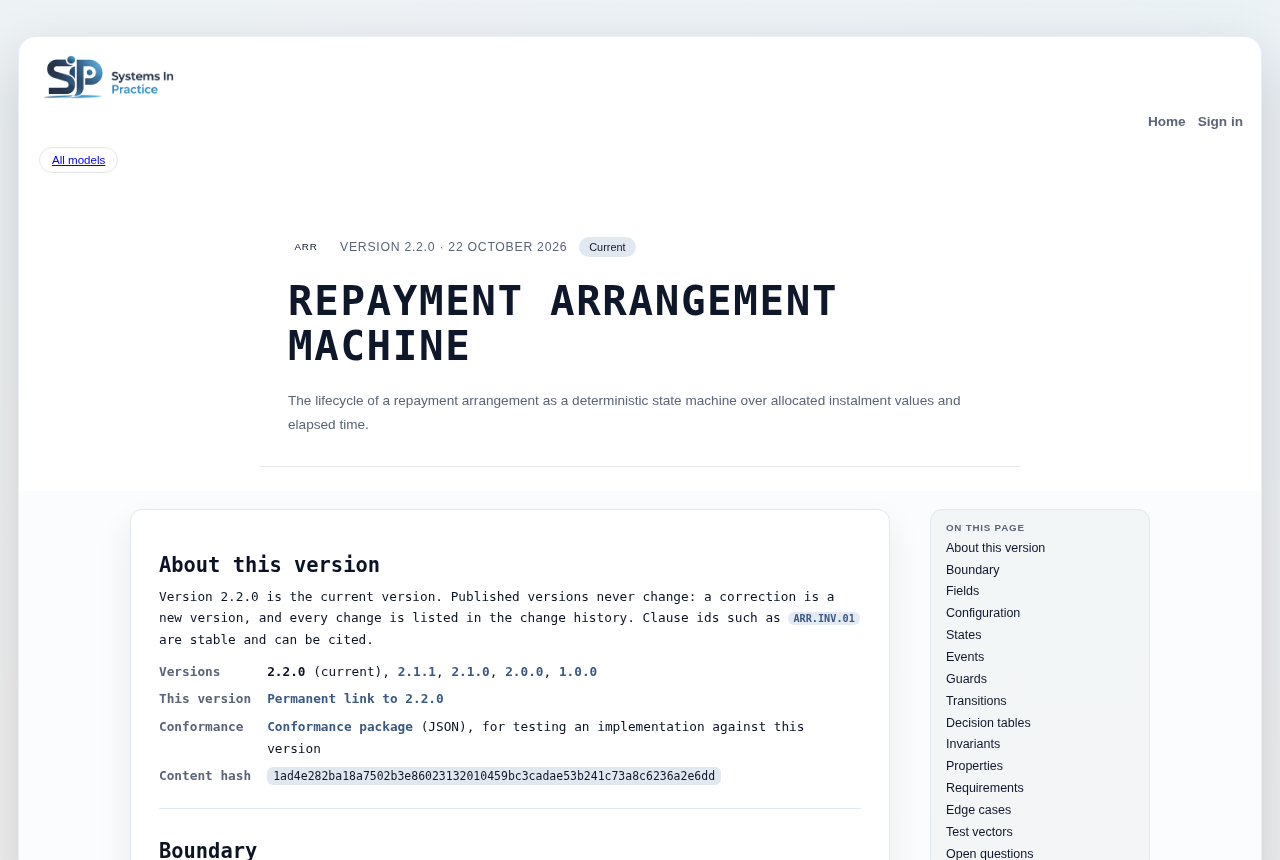
The public page for the Repayment Arrangement Machine model, version 2.2.0, on Systems in Practice: its version list, a permanent link to this version, the conformance package and the content hash, with an on-this-page list of clause sections

A real model page, as readers see it.

  • Every published version listed, each one fixed
  • A permanent link to cite this exact version
  • The conformance package to test against
  • A content hash that proves nothing changed

Built for teams in

  • Financial services and payments
  • Insurance and claims
  • Public services
  • Standards bodies
  • Operating-model consultancies

Book a demo

Bring one rule you're not sure of.

We'll model it with you, bind an explanation to it and test an implementation against it, in one session.